Study in Malaysia, Graduate in Australia: The Pathway Explained

Introduction
Q. What is the Malaysia to Australia study pathway?
Q. How much can I save by starting in Malaysia instead of Australia?
Q. Do I need to go to a branch campus, or can I transfer from any Malaysian university?
Q. What IELTS score do I need for this pathway?
Q. Are the intakes fixed to once a year?
Q. Which courses have the clearest progression pathways to Australia?
Author Bio

As an education industry expert, she has worked closely with students navigating university shortlisting, applications, admissions decisions, and the uncertainty that often comes with studying overseas. Over the years, one thing has become clear: there is no single formula for a successful study-abroad journey. What works for one student may not work for another- and the most important decisions are often the ones made long before an application is submitted. Amrita writes about study abroad from that intersection of student experience, admissions, and communication. Her approach is practical and student-first, combining real-world insights with clear, thoughtful guidance to help students make better-informed decisions at every stage of their journey.
For many international students, studying in Australia is an attractive goal. However, the cost of studying in Australia, combined with academic and admission considerations, can sometimes make students explore alternative ways to begin their international education journey.
One option worth exploring is starting in Malaysia and progressing into Australia later in the degree.
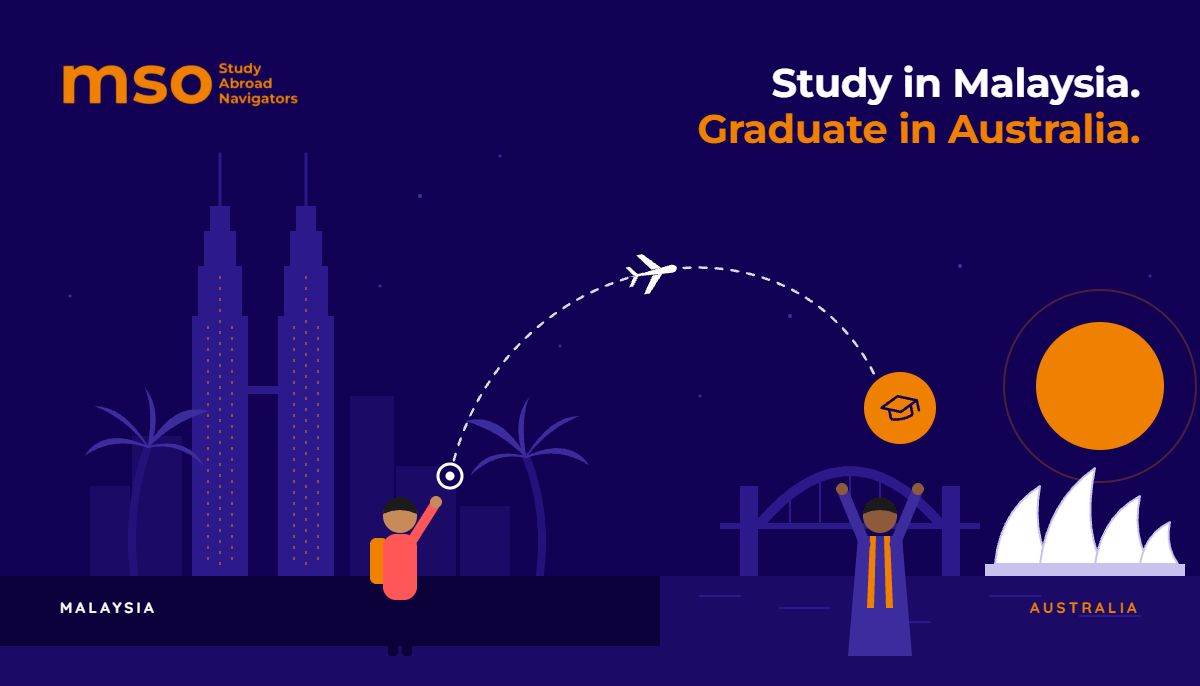
Instead of starting the entire education journey in Australia, students can begin their studies in Malaysia and, where an appropriate formal progression or credit-transfer arrangement exists, potentially continue their education in Australia. This approach can offer students greater flexibility, but it needs to be carefully planned.
How the Transfer Pathway Works
Starting this pathway typically begins with choosing the right entry point in Malaysia. Students can complete a foundation year, a diploma, or the first 1 to 2 years of a bachelor's degree at a Malaysian institution, building the same academic foundation they would have started with in Australia, at a fraction of the cost.Once that portion of the degree is complete, the next step is transferring the accumulated academic credits. Depending on the arrangement, credits can move into a partner university in Australia, where the transfer process is pre-agreed and considerably smoother, or into a non-partner university, where the receiving institution assesses the credits individually. Either route can work, but a partner arrangement generally means fewer surprises and a clearer timeline.
Some students choose to simplify this even further by studying at an international branch campus already based in Malaysia, such as Monash University or Curtin Malaysia. Because these campuses are extensions of their Australian counterparts, internal transfers between the Malaysia and Australia campuses tend to be more straightforward than transferring credits to an entirely separate institution.
These pathways are usually structured around a few common formats:
- 2+2, two years in Malaysia followed by two years in Australia
- 1+2, a foundation year in Malaysia followed by two years in Australia
- 2+1, an accelerated route with two years in Malaysia and a final year in Australia
Whichever structure a student follows, the outcome is the same: graduation with a full Australian degree.
Key Benefits of Starting in Malaysia
Starting a degree in Malaysia before progressing to Australia offers real financial and academic advantages, not just a cheaper alternative.Cost is usually the biggest driver, students following this route can save up to 40 to 60% on tuition compared to studying the entire degree in Australia. Because Malaysian universities and branch campuses teach in English, there's no language transition to manage either, classes, assessments, and campus life all run in English from day one. The curricula at these institutions are also globally aligned with their Australian counterparts, so students aren't studying a "lesser" version of the course, they're covering the same material before transferring. This also means the academic transition itself tends to be smooth rather than jarring, since the coursework, grading, and academic expectations are already familiar. On top of that, most pathway programs offer flexible transfer timelines, so students aren't locked into transferring at one fixed point if their circumstances change.
Cost Comparison: Malaysia vs Australia
Cost savings are one of the clearest advantages of this pathway, and the numbers make the case well.
| Stage | Location | Typical Cost |
| First 1–2 years | Malaysia | RM 20,000 – RM 50,000 total |
| Remaining years | Australia | AUD 25,000 – 40,000 per year |
Taken together, students following this pathway can save up to 50% of the total degree cost, along with meaningfully lower living costs during the years spent in Malaysia. This combination is what makes it one of the most affordable study abroad pathways available to students aiming for an Australian qualification.
Australian University Branch Campuses in Malaysia
For students who prefer the certainty of a direct branch campus over a separate credit-transfer arrangement, several Australian universities already operate campuses in Malaysia. MSO's Australian university partners in Malaysia include:
- Monash University
- University of Wollongong
- Swinburne University of Technology
Private Universities Offering Transfer Programs
Beyond branch campuses, a number of private universities in Malaysia run their own transfer programs into Australian institutions. These include:
- Taylor's University
- Sunway University
- INTI International University
- SEGi University
- Asia Pacific University
One practical advantage of these private universities is their intake structure. Rather than a single admission window each year, they run rolling intakes, meaning students can enter through Foundation or Diploma levels at multiple points throughout the year rather than waiting for one fixed intake date.
Eligibility Requirements
Qualifying for a Malaysia to Australia transfer program generally comes down to a standard set of requirements:
- Completion of high school (CBSE, A-Level, etc.)
- English proficiency, typically IELTS 5.5 to 6.5 depending on the level of entry
- Academic transcripts
- A valid passport
- Strong academic performance, since transfer eligibility often depends on maintaining consistent grades through the Malaysia portion of the degree.
Popular Fields of Study for Progression to Australia
Several fields are particularly well suited to this pathway, largely because they have well-established progression routes between Malaysian and Australian institutions:
- Business
- Computing
- Hospitality & Tourism
- Engineering
- Health Sciences
- Pharmacy
- Arts & Social Sciences
Frequently Asked Questions
Q. What is the Malaysia to Australia study pathway?
It's a route where students begin their degree in Malaysia, either at a foundation, diploma, or early bachelor's level, and later transfer into an Australian university to complete their qualification, graduating with a full Australian degree.
Q. How much can I save by starting in Malaysia instead of Australia?
Students typically save 40 to 60% on tuition during the Malaysia portion of their degree, and up to 50% on the total cost of the degree when factoring in lower living costs during those years.
Q. Do I need to go to a branch campus, or can I transfer from any Malaysian university?
Both options exist. Branch campuses like Monash, University of Wollongong, and Swinburne offer more straightforward internal transfers since they're extensions of their Australian campuses. Private universities like Taylor's, Sunway, INTI, SEGi, and APU also run their own transfer programs, though credit assessment for non-partner destinations is handled case by case.
Q. What IELTS score do I need for this pathway?
Requirements typically range from IELTS 5.5 to 6.5, depending on whether you're entering at the foundation, diploma, or degree level.
Q. Are the intakes fixed to once a year?
Not at the private universities. Institutions like Taylor's, Sunway, INTI, SEGi, and APU run rolling intakes, so students can start at multiple points during the year rather than waiting for a single annual admission window.
Q. Which courses have the clearest progression pathways to Australia?
Business, Computing, Hospitality & Tourism, Engineering, Health Sciences, Pharmacy, and Arts & Social Sciences are the fields with the most established progression routes.
The Bottom Line
This pathway can be an attractive option for students who want to pursue an Australian education while looking for greater flexibility in terms of cost, location, and study planning. Starting in Malaysia can provide access to internationally recognised institutions, English-medium education, and, where formal articulation or credit-transfer arrangements are available, a structured route towards completing a qualification in Australia.
With the right program and progression arrangement, Malaysia can serve as a practical starting point for students aspiring to complete their education in Australia, giving them the opportunity to build their international study experience step by step while managing their overall education investment.
Start with a Free 1:1 Consultation today.


